X-Ring product guide
X-Ring
Four-lip sealing profiles for dynamic and static applications requiring low friction and reliable sealing.
- Four-lip profile
- Reduced twisting tendency
- Application-based materials
Product overview
Understand the Product Before Selecting a Specification
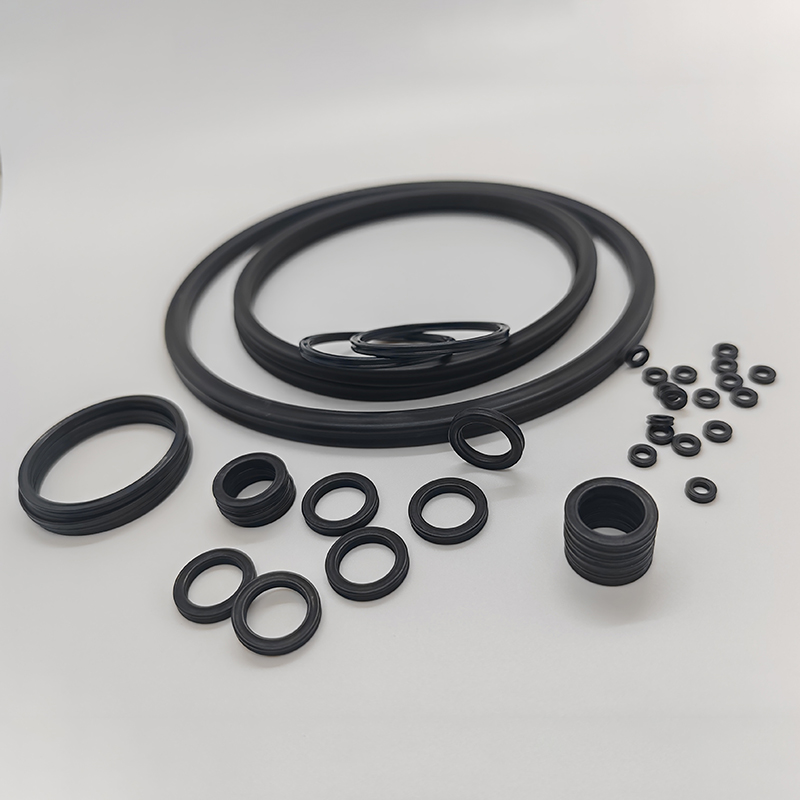
ouning supplies X-rings for industrial equipment where reduced twisting, stable lubrication, and dependable sealing are important. Material and size recommendations are available against your working conditions.
Four-lip profile
Multiple sealing lines and lubricant-retaining spaces can support stable sealing in suitable dynamic applications.
Reduced twisting tendency
The profile can offer greater stability than a conventional round section where rolling or spiral failure is a concern.
Application-based materials
Material and hardness should be selected against the media, temperature, pressure, speed, and service environment.
Product scope
Applications, Materials, and Supply Options
Use these categories as a starting point. The final specification depends on the complete application.
Common Applications
- Hydraulic and pneumatic equipment
- Rotating shafts
- Valves and pumps
- Industrial machinery
Material Options
- NBR
- FKM
- EPDM
- Silicone
Supply Capabilities
- Standard and custom sizes
- Material selection support
- Sample and batch production
- Dimensional inspection
Before requesting a quote
Selection Factors for X-Ring
More complete input leads to a clearer product and material discussion.
Groove dimensions
Provide the groove diameter, width, depth, clearances, and surface condition where available.
Motion and speed
Confirm whether the seal is static, reciprocating, rotating, or oscillating and include the operating speed.
Working conditions
State the media, continuous and peak temperature, pressure range, and expected service cycle.
Validation needs
Include any sample quantity, inspection dimensions, test method, or approval process required for the project.
Project workflow
A Practical Review Process
The steps remain clear whether you are identifying a standard part or developing a custom specification.
- 01
Define
Share the product, drawing, dimensions, service conditions, and quantities.
- 02
Confirm
Align the material, hardness, tolerances, tooling, samples, and documentation.
- 03
Validate
Review samples and complete the application-specific approval process.
- 04
Supply
Maintain confirmed specifications and identification for repeat requirements.
Questions & answers
X-Ring Questions
Common questions about selecting and requesting x-ring.
Can an X-ring directly replace an O-ring?
Not automatically. The groove, squeeze, clearances, motion, pressure, and material must be reviewed before changing the seal profile.
Which material should I choose for an X-ring?
The choice depends on the working media, temperature, pressure, motion, and service environment. Share these conditions for a practical material review.
Can you review a custom X-ring size?
Yes. Send a dimensioned drawing or groove information together with the application conditions and required quantity.